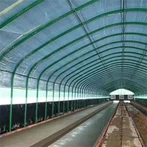
Agricultural greenhouse is a new type of agricultural cultivation facility that utilizes the radiation energy of the sun to provide the temperature and humidity required for plant growth. Due to the lack of heating and insulation in winter, it is possible to fully utilize night or cloudy days for vegetable production and planting, improving production efficiency and increasing benefits.
1. Structural composition:
(1) Main skeleton:
The main framework is composed of columns (beams), longitudinal bars (slant support), arch bars and other components. The column is the main load-bearing component of the scaffolding; The longitudinal rod is connected to the arch and bears the upper load; The crossbeam plays a supporting role and is connected to the column to form a spatial stress system, with its two ends fixed and connected to the pressure film line.
(2) Cover material:
The covering materials include plastic film, glass, PC board, insulation blanket, shading net, etc. Glass and plastic films mainly play a role in preventing rain and snow; Insulation blanket is used to cover crops and their protective layer; Sunshade nets are mainly used for cooling, freezing prevention, and preventing direct sunlight from shining on crops.
2. Construction method:
(1) Basic treatment:
The foundation treatment of greenhouses generally adopts the method of digging pits and burying soil for construction: first, dig a trench with a depth of about 30 centimeters along the north-south direction as a drainage channel, and then dig a trench with a depth of about 50 centimeters along the east-west direction as a drainage and irrigation channel; Then fill and compact the soil as required to complete the foundation treatment work. Attention: If encountering special geological conditions, it is necessary to handle them according to the specific situation before construction.
(1) Soil conditions:
Choose a location with fertile soil and good drainage to build the site;
(2) When the groundwater level is high, dehumidification measures should be taken;
(3) When the groundwater level is low, waterproof measures should be taken;
(4) When the bearing capacity of the foundation is insufficient, replacement or dynamic compaction can be used to reinforce the foundation;
(5) Saline alkali soil should be improved before building greenhouses.
(6) An appropriate amount of sand and gravel should be added to cohesive soil to reduce its viscosity.
(7) For waterlogged areas, water retaining walls should be installed to prevent rainwater from entering the shed and causing waterlogging.
(8) For high and cold areas, insulation measures should be considered to ensure that the indoor temperature is not less than -10 degrees Celsius.
(9) If encountering strong winds, the ventilation openings should be closed to reduce the incidence of damage to the wall structure caused by wind damage.
(2) Setting out:
According to the requirements of the design drawings, measure and set out the dimensions and elevations of each part, and then draw a plan and profile map and annotate them (such as height dimension annotation).